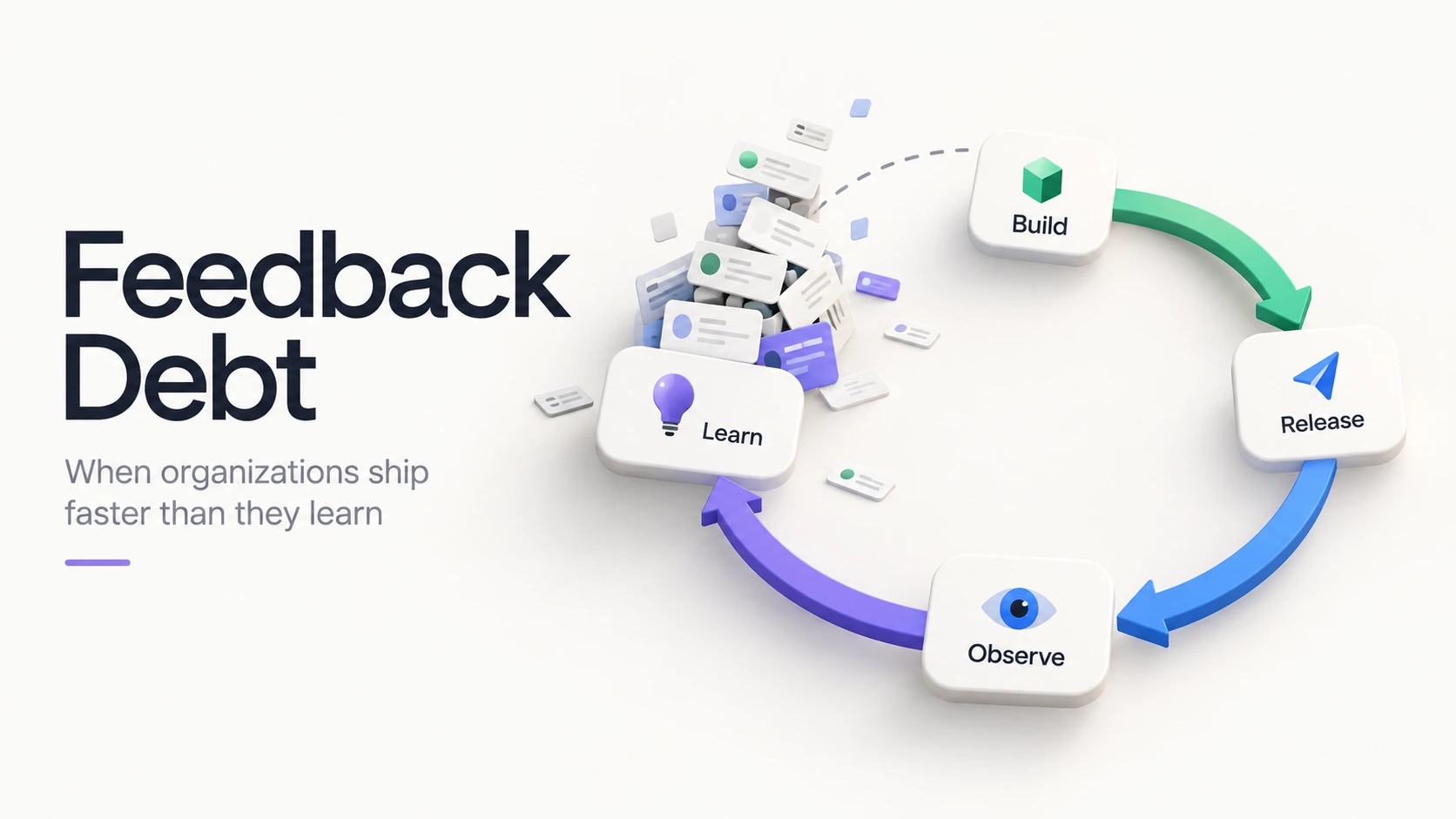
Something strange is happening in many companies: their ability to produce work is growing much faster than their ability to learn from its results.
AI makes this problem even more visible. Requirements can be written faster, code generated faster, tests created faster, and changes released faster. Work that once took several days can, under favourable conditions, be completed within a few hours.
At first, that sounds like a productivity gain.
And it is.
But only if the organisation still knows afterwards whether what it produced faster actually improved anything.
This is where Feedback Debt emerges.
Feedback Debt describes the growing amount of work, decisions, and changes whose actual impact has never been evaluated, or is evaluated only much later. It is a kind of organisational debt that builds up when implementation moves faster than feedback.
And many companies have accumulated a surprising amount of it.
Companies have become excellent at starting work
New requirements arise almost everywhere.
A business department identifies a need. A customer makes a request. Management approves a new strategic initiative. A workshop generates actions. A retrospective produces improvement tasks. A project identifies more work packages.
Then the machinery starts.
Tickets are created, prioritised, specified, estimated, planned, implemented, tested, and eventually released to production.
For this part, processes are often remarkably sophisticated.
There are backlogs, boards, project plans, roadmaps, status reports, portfolio meetings, steering committees, and dashboards.
What exists far less often is an equally systematic answer to a much simpler question:
Did it work?
Not:
Was it released?
Not:
Is the ticket closed?
Not:
Is the project status green?
But:
Did the change actually improve what it was intended to improve?
The question sounds trivial. In many organisations, it is surprisingly hard to answer.
“Done” usually just means the work is over
Software development has a strong tendency to define success in terms of output.
A feature was released.
An interface was built.
A process was digitised.
A new dashboard is available.
The project was completed.
The work then disappears from the board and attention moves to the next topic.
Organisationally, this is understandable. New requirements are already waiting, stakeholders expect progress, and the next initiative is well underway.
Yet this is precisely how Feedback Debt builds up.
Every change leaves unanswered questions behind.
Do people actually use the new feature?
Has the intended process improved?
Was time actually saved?
Are there fewer errors?
Has behaviour simply shifted elsewhere?
Have unintended side effects appeared?
Was the original assumption correct at all?
As long as these questions remain open, the organisation has more software, but not necessarily more knowledge.
Feedback Debt starts out invisible
Technical debt eventually makes itself felt.
Changes take longer, systems become more fragile, tests more complicated, and developers begin to approach certain parts of the code with a slight sense of unease.
Feedback Debt behaves differently.
A feature can be implemented exceptionally well and still create no meaningful value.
The system works.
The tests pass.
The architecture is sound.
It is just that nobody needs it.
This situation can remain undetected for a surprisingly long time because traditional management mechanisms mainly track whether work was completed, and much less often what that work achieved.
This creates a dangerous effect: missing feedback does not initially look like a problem.
It looks like progress.
In large organisations, this debt grows particularly easily
The larger an organisation becomes, the further those who make decisions often move away from those who experience their actual effects.
Several organisational layers may sit between a product idea and its impact.
Management.
Portfolio.
Business department.
Product management.
IT.
Development team.
Operations.
Customer service.
Users.
Information emerges at every one of these points. But it does not automatically flow back.
A support team may have recognised a particular usage pattern for months. Product development, however, only sees tickets.
A business department notices that a new process is regularly bypassed. The project that introduced it was closed long ago.
Monitoring shows that a feature is barely used. Yet its next extension is already on the roadmap.
The problem is rarely a complete lack of data.
Far more often, the connection between that data and the next decision is missing.
Feedback exists.
The loop simply is not closed.
Projects are particularly effective Feedback Debt machines
The traditional project model has a structural weakness: it often ends at precisely the point where learning should really begin.
Before the project, considerable energy is invested.
Business cases are prepared, goals defined, budgets requested, and expectations described.
During the project, management is intensive.
Timelines, costs, scope, risks, and deliverables are tracked.
Then comes go-live.
The project is closed.
The team disbands.
Budget and attention move elsewhere.
This often removes the very organisational structure that could check whether the original assumptions actually held true.
The result is a paradox.
Before an investment, impact hypotheses are formulated to justify it. After the investment, there is far less systematic evaluation of whether those hypotheses were correct.
The business case was necessary to get the work started.
Nobody feels responsible for the learning afterwards.
AI intensifies this problem
As long as development was expensive and slow, production capacity automatically limited the volume of new changes.
There was simply no way to implement an unlimited number of things at once.
AI changes this relationship.
Code becomes cheaper.
Prototypes appear faster.
Variants become easier to try.
Requirements can be implemented faster.
The bottleneck shifts.
An organisation’s decisive capability will increasingly no longer be its ability to produce as much software as possible.
It will be its ability to quickly find out which software should be produced in the first place.
An organisation that doubles its implementation speed without changing its feedback speed therefore does not automatically become twice as good.
It may simply generate Feedback Debt twice as fast.
More speed amplifies weak loops
This is one reason why AI does not automatically fix poor organisational structures.
It initially amplifies the existing system.
If requirements are unclear, unclear requirements can be implemented faster.
If priorities are poorly chosen, poor priorities can be delivered faster.
If impact is not evaluated, even more features can emerge without any verified impact.
Productivity does not solve a feedback problem.
On the contrary: the faster production becomes, the more important feedback becomes.
A fast engine is of little use if the steering wheel is not connected to the vehicle.
Feedback must become part of the work
The obvious reaction is often to introduce more reporting.
Another dashboard.
Another set of KPIs.
Another review meeting.
But this rarely solves the underlying problem.
Feedback does not emerge merely because information becomes visible. It emerges when information influences a future decision.
That is precisely why the question of impact should not be raised only after implementation.
It must start beforehand.
What should change?
For whom?
How would that change be recognised?
What data could show it?
When will it be evaluated?
Who will make a decision afterwards?
This changes the definition of work.
A change is no longer complete as soon as it is in production.
It is complete when enough is understood about its impact and the consequences that follow.
This is where the Value Loop comes in
LoopsWork therefore deliberately distinguishes between the Build Loop and the Value Loop.
The Build Loop answers the question:
Can the change be implemented cleanly and reliably?
The Value Loop asks a different question:
Did the change produce the expected impact?
This distinction matters because technical correctness and actual value are two different things.
A perfectly implemented feature can be worthless.
A small, technically unremarkable change can have enormous impact.
That is why the Value Loop starts before implementation.
A change receives not only requirements, but also an expectation of its impact.
After release, usage, outcomes, and possible side effects are observed. What is learned then feeds back into the next decision.
This creates something that is surprisingly rare as a systematic practice in many organisations:
a closed feedback loop connecting idea, implementation, impact, and learning.
The scorecard makes feedback visible
One simple way to prevent Feedback Debt is to make expectations explicit.
LoopsWork uses a scorecard for this purpose.
Before a change, the expected impact is recorded alongside the signals that can later be used to assess it.
This does not need to be a complicated KPI system.
A few concrete questions are often enough.
What should improve?
Which metric or observation would indicate that improvement?
Which unwanted effects should be monitored?
When will the evaluation take place?
What decision will follow from the result?
This changes the conversation.
Instead of:
“The feature is finished.”
It becomes:
“The feature is finished. Now the evaluation of our assumption begins.”
Over time, this small difference can substantially change how an organisation works.
Feedback Debt cannot be paid down through one big programme
Organisations that have spent years barely evaluating impact systematically do not suddenly need to analyse every historical project.
That would probably just become the next major project.
What matters more is to stop accumulating new debt.
A few rules can already make a substantial difference for new changes:
No major initiative without an explicit impact hypothesis.
No impact hypothesis without an observable signal.
No go-live without an agreed date for evaluation.
No evaluation without a resulting decision.
Learning then stops being an additional activity alongside the real work.
It becomes part of the work.
Real productivity comes from doing less of the wrong work
The discussion about AI currently focuses heavily on how much faster software can be developed.
That is understandable.
In the long term, however, another capability could matter much more.
Not building faster.
But recognising faster what should not be built further.
An organisation that recognises an incorrect assumption early may save months of future development.
A small experiment can be more valuable than a large project.
A feature that is never built can make more economic sense than one that is perfectly implemented.
And deciding to discontinue something can be a sign of effective product development.
Feedback Debt prevents precisely these decisions.
Without feedback, every original assumption continues to appear valid.
Software development needs closed loops
AI substantially increases the possible speed of software development.
But it also increases the speed at which incorrect assumptions can be implemented.
The answer cannot be to make development artificially slow again.
The feedback loops must become faster.
Build.
Value.
Learn.
As a recurring cycle rather than a linear process chain.
In a world where software can increasingly be produced cheaply, the decisive competitive advantage will not be the amount of software produced.
It will be the speed at which an organisation learns from reality.
The most dangerous debt in an AI-accelerated organisation could therefore one day no longer be Technical Debt.
But Feedback Debt.